H3 - Fire Safety

Short Version
Fire safety is one of the most critical parts of any building, even though most people never see it working. You expect that if a fire starts, you’ll have time to escape, the fire won’t spread rapidly through the building, and nearby buildings won’t be put at unnecessary risk. That expectation is exactly what Part H3 – Fire Safety of the NCC is designed to deliver.
Part H3 in NCC 2022, Volume 2 sets the minimum requirements to protect people and property from fire. Its primary purpose is to reduce the risk of injury or death, limit the spread of fire, and help ensure that a fire does not escalate into a larger or more dangerous event.
H3 addresses how a building:
- Resists the spread of fire between rooms and storeys
- Limits fire spread to neighbouring buildings
- Provides occupants with sufficient time to escape
- Reduces the likelihood of early structural failure during a fire
This is achieved through requirements for fire separation, fire-resisting construction, safe materials, and appropriate protection of critical building elements. The focus is not just on stopping fires, but on controlling how a fire behaves once it starts.
Importantly, H3 recognises that fire safety is about time. Time for occupants to become aware of a fire, time to move to safety, and time for emergency response. A building that collapses early or allows fire to spread unchecked fails this basic objective, even if it appears compliant on paper.
Like other parts of the NCC, H3 is outcomes-based. It does not exist to prescribe a single way of building, but to ensure the building performs safely under realistic fire conditions.
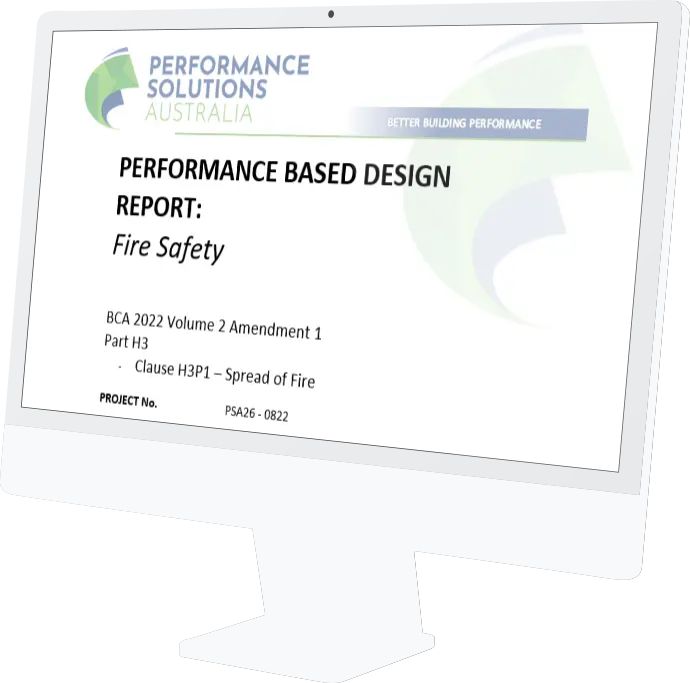
Why a Performance Solution May Be Needed for Part H3
Many residential buildings achieve fire safety compliance by following standard Deemed-to-Satisfy construction rules, such as minimum fire separation distances, wall and floor fire-resistance levels, and material restrictions. However, fire safety becomes more complex when a building does not fit the standard mould.
A Performance Solution for H3 – Fire Safety may be required where a design includes non-standard layouts, reduced setbacks, unconventional materials, mixed building classifications, or innovative construction systems. Examples include walls closer to boundaries than normally permitted, alternative wall or floor systems, exposed structural elements, or designs that vary from typical fire compartment layouts.
In these situations, the standard prescriptive rules may not directly apply, even though the building can still meet the underlying fire safety intent. A Performance Solution allows fire risk to be assessed based on actual performance, rather than strict adherence to predefined construction details.
This process typically considers how fire could start, how it might spread, how long key building elements remain stable, and how occupants can safely evacuate. The solution demonstrates that, despite being different, the building still achieves the same level of safety intended by H3.
From a homeowner or builder’s perspective, a fire safety Performance Solution is about documented assurance, not reduced safety. It shows that fire risks have been carefully considered, understood, and controlled, particularly where standard solutions are not practical or appropriate.
In simple terms, a Performance Solution for H3 exists to ensure that innovative or constrained designs remain just as safe in a fire as conventional buildings — even when they don’t follow the usual rulebook.
Performance Solution Topics - H3
Buildings constructed close to property boundaries may require a Performance Solution to limit the spread of fire to and from adjoining buildings.
Non-standard wall, floor, or roof systems may require a Performance Solution to demonstrate adequate fire resistance and containment of fire and smoke.
Alternative materials or exposed structural elements may require a Performance Solutionto control fire spread and maintain structural stability during a fire.
Complex building layouts or mixed-use areas may require a Performance Solution to ensure safe evacuation and effective fire separation.
Reduced fire separation distances or departures from Deemed-to-Satisfy fire construction may require a Performance Solution to achieve an equivalent level of fire safety.

Want to read how we have helped out with H2 Performance Solutions?
Read about past projects we've helped out with below:

Fire Separation and Articulation Joints
Fire Engineering for Townhouses
Leaving no gaps for non-compliance